Sunday, January 28, 2018

Realist Poem

Concert

Lights go down
Voices rise
The rumble of the bass
a shiver down my spine
and the beat kicks in
Hearts pound in sync

Roof raising
Feet against the floor thudding
Sound waves
crashing on our eardrums
Screams vanish like
A drop in the ocean

Adrenaline rush
This electrifying energy
resonates
in the souls of everyone here
My ego evaporates
into stormy ocean of the mosh pit
ebbs and flows with the music

If only I could
live among the flashing lights
with music rattling my ribcage
My sternum feels like its cracking
and pure joy might erupt from my chest
If only this moment could last forever

The lights come back on
I start to hear
faint muffled murmuring of people
I file out of the venue, breathless
White heat leaves my body as I
step out into the cool night air

Tuesday, January 23, 2018

Week 3 Assignment

What is a poem good for? 

I think poems are good for communicating truth and abstract ideas in a figurative way, and for being specific and ambiguous at the same time. Poems can be powerfully immersive, or sometimes entertaining and humorous. 
Poems can be interpreted in many different ways (and symbolism is a part of this), and that's a wonderful way to discuss complex issues. Often, those issues are at the core of what it means to be human.

What was the hardest thing to you about writing a symbolist poem? How do you think you did?

The hardest thing was making sure the symbol was suitable for the emotion I was writing about. I'm not sure if the symbol I used for solitude (a lighthouse) was an appropriate one; I only thought of it because when I think of a lighthouse, it looks very lonely. 
As I extended the symbol, I found other aspects of the lighthouse that match with the idea of solitude -- the purpose of the lighthouse in many cases is to warn people to stay away, and solitary people often push people away. The final metaphor of the spiral staircase, likened to a coiling snake conveys that loneliness can be painful and restricting. In addition, spirals are chaotic, and the sense of descent and constriction is another facet of solitude.
It was only when reading the poem aloud during peer review that I noticed some slant rhymes, particularly present in the last couple of stanzas (I should have read the poem aloud while writing it, of course. My mistake). This was a pleasant coincidence, though I'm not sure if it added or took away from the meaning of the poem. Rhymes can sometimes come off as childish or playful, other times they may create a sense of finality and closure. I'm not sure if I want to have closure at the end of this poem; I think the descent of solitude in this poem should be one that continues beyond the end of the poem. So if I were to rewrite this poem, I might change "python" to "snake" or "serpent", just to get rid of the rhyme.
All in all, I'm not sure how successful this poem was, especially as a symbolist poem. It's not obvious that the lighthouse is a symbol for solitude. But I tried to make use of what I most like to see in poetry: strong imagery and vivid language. Hopefully that is enough to make it a passable poem -- and with some rewrites and editing, maybe even a good one.

Saturday, January 20, 2018

Poem Assignment #2

Lighthouse
Stark silhouette against the sunset
Inky clouds converge,
concealing pale moonlight

In violent storms, its shining beacon
cautions sailors come not nearer,
lest they be dashed upon the rocks

Declaring its presence
only for them to turn away
be safe, be safe, be safe

From the clifftop, watching
sailors like ants scrambling
on the slippery decks of their ships

Within, the spiral staircase
coils and tightens;
a constricting python

Meaning in Poetry

I think how important meaning is in poetry depends on the type of poem it is. For example, "Jabberwocky" by Lewis Carroll doesn't have any concrete meaning, but it's still an enjoyable poem. Meaning holds a somewhat ambiguous place in poetry; a poem may not have a definite meaning, but poetry can't mean just anything either. It's also sometimes unclear what a poem means on the first reading. But I don't think uncovering a poem's meaning is the sole purpose of reading a poem -- there is diction and rhythm and structure to enjoy, too.

In a previous poetry class, I was introduced to the idea of the poet-poem-reader triangle. The poet may or may not write with a meaning in mind, but different meaning may be ascribed to those words by a reader. 

I think meaning is important in the visual arts, although in a different way. In visual arts, there tends to be a greater appreciation for skill, especially in figurative or representative art; if it's a really great figure drawing or impressive hyper-realistic life painting, meaning may not be as important. Not that skill and meaning are mutually exclusive, of course. The difference lies in how words inherently communicate ideas and therefore meaning, but visual art can be meaninglessly aesthetically attractive. I think whether or not a piece of poetry or visual art means something, and how much it means, is a choice on the part of the poet or artist. How clearly that intent comes across to the audience could perhaps be a measure of the artist/poet's success.

I don't know that there's a limit to how hard you can try to understand something. I suppose if you're trying to tease a meaning out of a poem that isn't supported by the text, that'd be trying too hard. This is best described in the last two stanzas of a poem by Billy Collins, called "Introduction to Poetry":

But all they want to do
is tie the poem to a chair with rope
and torture a confession out of it.

They begin beating it with a hose
to find out what it really means.

Understanding poetry isn't really about how hard you're trying, but rather how you approach a poem. Trying to fix a solid, unchangeable meaning to something as fluid as a poem is not going to allow you to discover the best that a poem has to offer. Rereading poems at different times and in different contexts, and finding new meanings is, to me, part of the joy of poetry.


Wednesday, January 17, 2018

Writing Process


I can pretty much write on cue, depending on what it is I need to write. If it's something unusual, it's harder for me to write -- for example in another class I had to write from the point of view of an existing, real-life person and I just couldn't do it; it was too strange. In most cases however, I'm happy to write. I tend to write best in quiet, private places and at night, and without time constraints.

When I write prose, whether it's a narrative or an essay, I usually start with a “sketch” — a point-form version of the ideas I intend to communicate. Once I have that, it's easy for me to expand on those points and come up with a full piece of writing. Then I edit until the result is up to my standards.

Often I find that my writing process is part of my thought process. As I write, I give a solid form to my ideas, providing clarity and allowing me to develop those ideas further, and my train of thought to progress. 

My approach to poetry is similar, but the process consists of more rewrites than edits. Because poetry is about the language, as opposed to using language to communicate an idea, it requires a lot more sensitivity and attention to each individual word. 


What Makes A Good Poem?

Vivid Imagery
I think one of the best things about poetry is it's immersive or transportive capabilities. The best way to do that is through imagery, and the poems that have the greatest impact on me often have powerful, striking imagery.

Successful Diction
Poems are made of words, so picking the right words is crucial. Other than meaning, the words have to give the right rhythm and tone to the poem.

Levels
A good poem can be enjoyed on several levels. The words and structure itself should be pleasing and effective in conveying a specific tone. The poem might also have a deeper meaning or a sort of ambiguity, leaving room for interpretation on the part of the reader. A good poem invites the reader to participate in giving it meaning.

Brevity
This is more of a personal preference. Obviously there are a lot of classic, excellent long poems. But I appreciate brevity in a poem, I think it makes the poem a lot more impactful and enjoyable.

Wednesday, January 10, 2018

An Ekphrastic Poem


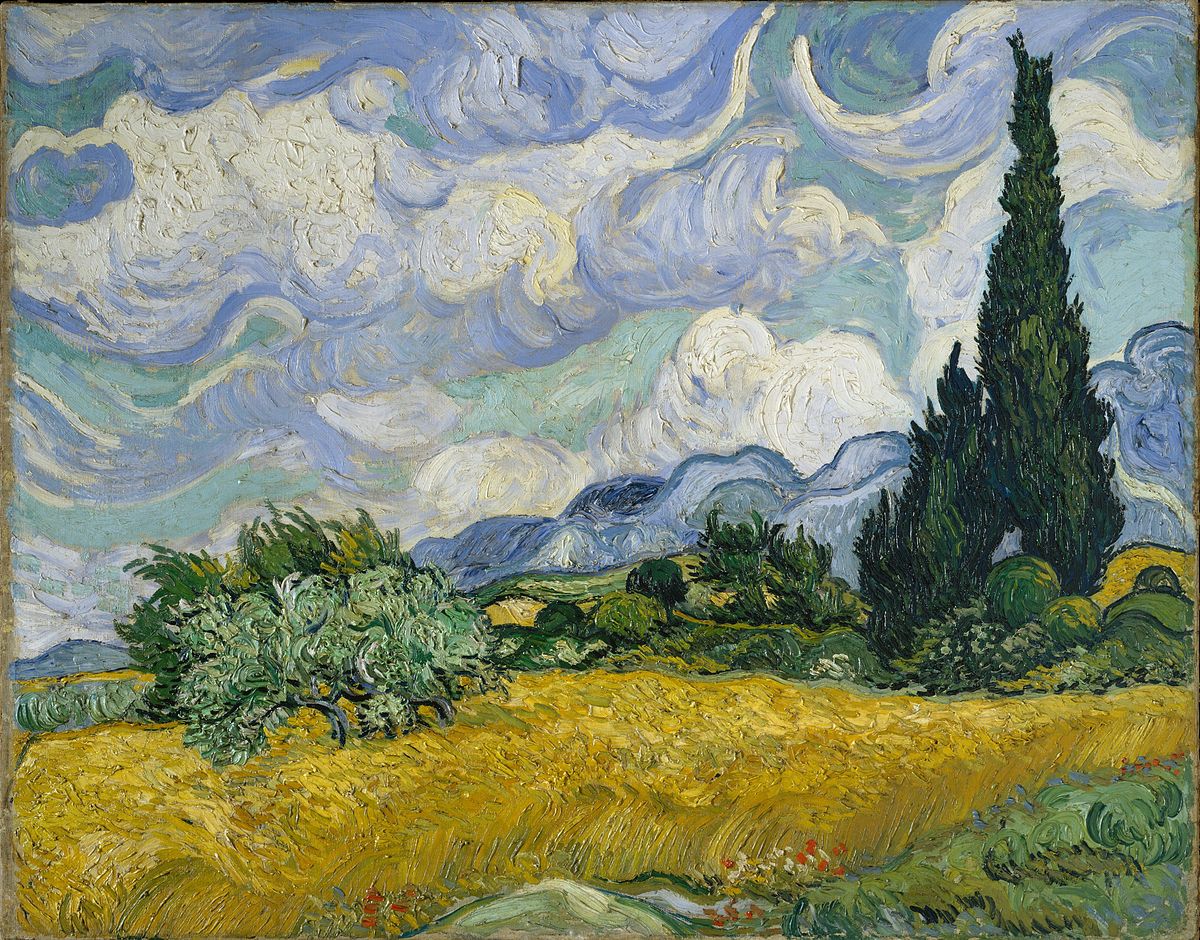
wind rustling through emerald foliage
swaying golden wheat stalks 
great, billowing blue clouds
like a stormy ocean’s violent waves
impasto brushstrokes melting into each other
in graceful, vigorous harmony
convergence of light, color, movement
a singular point in time

Nature, this is how I feel you;
a moment, inimitable