Wednesday, April 25, 2018

Final Blogpost

1. What did I learn from this class?
I came into this class already knowing a bit about poetry, so I was familiar with many of the craft aspects of writing poetry, but not the history of poetry. I was unfamiliar with many famous poets and works from the last century that were brought up in class. So it was nice to get a list of poets that I can read and enjoy over summer.
I learned about different historical movements in poetry, as well as the related art movements. I also learned of significant poets from each of those movements. This class really broadened my formal knowledge of different types of poetry. I am better able to recognise whether a poem is ekphrastic, cubist, impressionist, symbolist, found, list -- or at least if they are referencing those movements, which can be very important in reading literature. Each type of poetry is itself inspiring when beginning a poem: what kind of shape would best fit the feeling or experience I'm trying to convey in this poem?
Because of the mostly chronological order of the syllabus, it was also something of a history lesson. And it always shakes me to know how much the surrounding sociological and cultural circumstances impact the art that people create. Things like WWII, the AIDS crisis, 9/11, and whatever the hell is going on right now -- these things had such a huge impact (at least, in the Western hemisphere) and the type of work, if not subject matter, that was created really reflects that. It makes me wonder how much my work reflects the social/cultural/political climate I live in, since I'm not consciously writing to reflect that.
 I also learned some new methods for starting a poem. That's always handy.
2. Given what you have learned about the last 100 or so years in the visual and literary arts, what would you say the role of the artist is in society today?
I would say the role of the artist is to tell their story, to write or create work that they feel is important and worth creating. Art tends to be an artist's response to things going on in their lives, or events that truly affect them or just things they feel strongly about. It's a record of humanity in a certain era.
Art also has the power to move people, to challenge norms, to be a force for change. But I don't think it's a requirement for an artist to be an activist in that sense. It's just kind of neat, and it's there if it's needed. It would be grandiose to suggest that the role of the artist is anything more than to make things they feel compelled to make; I don't believe that an individual should be robbed of the joy of creating things because they feel like they have to make something that's political or bigger than themselves in order to be worthy of the "artist" label. 
I don't think the role of the artist has changed over the last 100 years. From what I know of art history (although I am by no means an expert), people just made stuff in response to what they saw, because they thought it was important and needed to be said, or just kind of interesting or appealing. I think that's all any artist or student of art can reasonably be expected to do.

Final

https://vimeo.com/266557956

Sunday, March 25, 2018

Concrete Poem

Two Lucky Ones

we   have been
together   since the womb
one zygote   split into two embryos
so tightly bound   together unformed limbs
kicking against the   uterine walls of our mother
and each other. as we grow   we continue sharing: beds,
food, clothes; same voice, same   laugh, same crooked teeth
simply conveyed by meeting eyes or   unusual posture. I read you
like an open book, and I know you   do the same for me.
some people spend their entire   lives looking for
soulmates in lovers or   loyal friends;
but i am one of the   lucky ones
I was born   with mine
my     twin.

Saturday, March 17, 2018

Found Poem

Ready Now?

a guy in a loud suit with wandering eyes
sang, danced, orated, acted the clown,
labeled hysterical, Chicken Little, apocalyptic.

war is what they see on TV,
junk fiction, poisonous rubbish
making strides. The other shoes don’t fit.

city of ruins, optimistic materialists,
you must deny death.
it serenely disdains to annihilate us.

the sky was so blue, and
for once in a long time, i felt at peace.
the people who rationalise a better world,


Ready now?

Sunday, February 25, 2018

Narrative Poem

How Can I Improve My Dice Rolls? 

This is a story about a girl who plays a table top RPG.

Game night comes to a close
and the girl’s character is in her death throes
It’s been another night of rolling ones, twos, threes…
She has bad luck, and her teammates agree;
so in a sad funk, she heads on home,
and googles, "How can I improve my dice rolls?"
and on page six, the sixth result;
alas, a six-step answer to her woes…

Step One (it goes), Shake the dice.
Clasp them in your hands,
shake them thrice.

Step Two, (sound file attached) Recite the magic words. 
Listen to the sound clip above and repeat exactly what you hear.
Whisper it into your hands -- and you might need to rehearse --
It's Genesis chapter three… in reverse. 

Step Three, (video file attached) Draw the magic circle. 
Now extend your left hand, and this part is hard --
You must ensure the blade is clean and sharp.
Then carve the circle as demonstrated
on the back of your hand -- Not on your palm!
Cause that’s more painful and you won’t be able
to do anything with your hand for days.
If you’re worried about scarring, you can get it tattooed.
(It does make a pretty sick tattoo.)
But you’ll need the blood later anyway, so it's up to you.

Step Four, Be polite.
At this point the devil will appear, 
in a puff of smoke or a flash of light.
Don't freak out, he’ll look... somewhat severe.
He is the devil, he’s not meant to look nice.
Anyway, he’ll start to deliver his spiel.
Now, you’re here to hash out a deal,
so don't let him cheat you, for real, listen close, 
He is the devil, so stay on your toes;
You are paying with your immortal soul.

Step Five, Sign in blood.
When your terms are clear and there’s no more doubting,
it’s finally time to put your money where your mouth is. 
Here’s where the magic circle carving comes into play.
If you tattooed it, you’re still gonna want that blade.
Cut across your wrist, not down it — 
you don’t want to commit suicide — 
but there’s no painless way around this— 
He is the devil, a sly wily guy…

Step Six, Start rolling those six-six-sixes!
Once the devil vanishes with your immortal soul in tow
It’ll be really easy to achieve your in-game goals.

The girl reads this, steels herself,
and follows the steps with determination.
The devil appears; she offers her payment. 
And now, when her RPG team gets into terrible fixes,
every dice she throws, she rolls sixes...

…even when she rolls D7 to 20s.

That’s what happens when you deal with the devil.

The end.

Sunday, February 18, 2018

Sound Poem

Talking

just keep talking
just keep talking
just keep tttttalking
stammering, yammering, stuttering
stumbling over your sentences

keep spouting your nonsense
it won't make a difference
keep that tongue clicking
lips pouting teeth gritting
machine gun volley of words

spit out into the open air
those ticking time bombs 
listen to ‘em hang there
exposing all your wrongs
ropes round their necks
choking, sputtering rows of text

Wednesday, February 14, 2018

Cubist Poem

Black Cat

inky kitty sits on the windowsill
scrutinising the garden outside
notices me walking towards the kitchen
slinks down over sleek figure
bounding towards the kitchen meowing
sleek kitty slinks over hungry meowing 
bounding inky figure scrutinising the
kitchen hungry slinking bounding inky
kitty hunting on the windowsill
bounding in the garden outside

now, feast,

sleek inky beast.

Wednesday, February 7, 2018

List Poem


Little Red Boat

I remember a toy boat I had when I was six.
I remember it was small and red.
I remember its plastic was going pale and rough on the edges;
I remember its worn, dulling surface.

I remember it went on the little waterway playset.
I remember that was on white tiled floor outside the preschool,
I remember the floor was slippery with dirty water.
I remember teachers filling the playset with water from a green rubber hose, while us children chose boats from a plastic rack.
I remember that there were all sorts of boats on the plastic rack: shining, stark boats that looked like speedboats or liners or tugboats;
I remember I always looked for the little red boat.

I remember looking for the little red boat one day and not finding it.
I remember the chaos and frenzy as other children rushed to grab the best boats off the rack,
I remember my vision blurring, and warm tears on my face, even in the humid weather,
I remember teachers asking me what’s wrong — 
I remember telling them I can’t find my boat— where is my boat?
I remember Miss Alison coming to me, the red boat in hand

“It was in my car boot. I thought this was an old boat and nobody wanted it.
I was going to give it away, to the Salvation Army.”

She gave me the boat. I took it home.
I still have it, it sits in a drawer collecting dust now.
But my memory of that boat
is always gleaming and bright,
with its worn plastic and faded red.

Sunday, February 4, 2018

Imagist Poems: Status Symbols

Car

growling engines
line the broad roads;
whose roars?

Condominium

great gleaming towers
soaring skywards,
each clear glass window
like a little cell
of an unyielding organism.

Credit Card

silver stripes on stiff plastic
swiping painlessly,
flaunting purchasing power.

Cash

fat wallet bursting;
dog eared corners

peeking out the top --
no small denominations.
"The image is the poet's pigment. The image is not an idea; it is a radiant node or cluster. A vortex through which, and from which, and into which ideas are constantly rushing. It is as true for painting and sculpture as it is for poetry."

- Ezra Pound

First say how you determine where to break the lines in your poems, then read and respond to the Edward Hirsh handout (The Line) on how to know where to make line-breaks when creating a poem. 200 word minimum.

I usually write in free verse, with no rhyme scheme. When I first write a poem, I break the lines by breath and the idea or thought -- if a thought feels complete, I'll break the line. Sometimes I also end the line at the end of a sentence or phrase.
In rewrites however, I also pay attention to the length of the line. How do I want the poem to look on the page? Tall and narrow? A dense wall of text? I might also break the lines to highlight individual phrases or word at the end or beginning of the line. I experiment with different line breaks in the same set of words, to see what gives the best impact.
Line breaks are tricky and elusive, especially with free verse. Lineation has a huge impact on the way the poem reads, and therefore the reader's understanding of the poem. As Hirsch describes, lineation serves more than one purpose. It is specific to each poet and each poem - each poet sets the parameters and boundaries of the purpose and application of lineation in each poem. For example, in the excerpt from Creeley’s poem, each line yields a different meaning. I think the impact of lineation can be quite intuitive – even not really understanding lineation, one can determine what the lineation is doing for the poem.

Sunday, January 28, 2018

Realist Poem

Concert

Lights go down
Voices rise
The rumble of the bass
a shiver down my spine
and the beat kicks in
Hearts pound in sync

Roof raising
Feet against the floor thudding
Sound waves
crashing on our eardrums
Screams vanish like
A drop in the ocean

Adrenaline rush
This electrifying energy
resonates
in the souls of everyone here
My ego evaporates
into stormy ocean of the mosh pit
ebbs and flows with the music

If only I could
live among the flashing lights
with music rattling my ribcage
My sternum feels like its cracking
and pure joy might erupt from my chest
If only this moment could last forever

The lights come back on
I start to hear
faint muffled murmuring of people
I file out of the venue, breathless
White heat leaves my body as I
step out into the cool night air

Tuesday, January 23, 2018

Week 3 Assignment

What is a poem good for? 

I think poems are good for communicating truth and abstract ideas in a figurative way, and for being specific and ambiguous at the same time. Poems can be powerfully immersive, or sometimes entertaining and humorous. 
Poems can be interpreted in many different ways (and symbolism is a part of this), and that's a wonderful way to discuss complex issues. Often, those issues are at the core of what it means to be human.

What was the hardest thing to you about writing a symbolist poem? How do you think you did?

The hardest thing was making sure the symbol was suitable for the emotion I was writing about. I'm not sure if the symbol I used for solitude (a lighthouse) was an appropriate one; I only thought of it because when I think of a lighthouse, it looks very lonely. 
As I extended the symbol, I found other aspects of the lighthouse that match with the idea of solitude -- the purpose of the lighthouse in many cases is to warn people to stay away, and solitary people often push people away. The final metaphor of the spiral staircase, likened to a coiling snake conveys that loneliness can be painful and restricting. In addition, spirals are chaotic, and the sense of descent and constriction is another facet of solitude.
It was only when reading the poem aloud during peer review that I noticed some slant rhymes, particularly present in the last couple of stanzas (I should have read the poem aloud while writing it, of course. My mistake). This was a pleasant coincidence, though I'm not sure if it added or took away from the meaning of the poem. Rhymes can sometimes come off as childish or playful, other times they may create a sense of finality and closure. I'm not sure if I want to have closure at the end of this poem; I think the descent of solitude in this poem should be one that continues beyond the end of the poem. So if I were to rewrite this poem, I might change "python" to "snake" or "serpent", just to get rid of the rhyme.
All in all, I'm not sure how successful this poem was, especially as a symbolist poem. It's not obvious that the lighthouse is a symbol for solitude. But I tried to make use of what I most like to see in poetry: strong imagery and vivid language. Hopefully that is enough to make it a passable poem -- and with some rewrites and editing, maybe even a good one.

Saturday, January 20, 2018

Poem Assignment #2

Lighthouse
Stark silhouette against the sunset
Inky clouds converge,
concealing pale moonlight

In violent storms, its shining beacon
cautions sailors come not nearer,
lest they be dashed upon the rocks

Declaring its presence
only for them to turn away
be safe, be safe, be safe

From the clifftop, watching
sailors like ants scrambling
on the slippery decks of their ships

Within, the spiral staircase
coils and tightens;
a constricting python

Meaning in Poetry

I think how important meaning is in poetry depends on the type of poem it is. For example, "Jabberwocky" by Lewis Carroll doesn't have any concrete meaning, but it's still an enjoyable poem. Meaning holds a somewhat ambiguous place in poetry; a poem may not have a definite meaning, but poetry can't mean just anything either. It's also sometimes unclear what a poem means on the first reading. But I don't think uncovering a poem's meaning is the sole purpose of reading a poem -- there is diction and rhythm and structure to enjoy, too.

In a previous poetry class, I was introduced to the idea of the poet-poem-reader triangle. The poet may or may not write with a meaning in mind, but different meaning may be ascribed to those words by a reader. 

I think meaning is important in the visual arts, although in a different way. In visual arts, there tends to be a greater appreciation for skill, especially in figurative or representative art; if it's a really great figure drawing or impressive hyper-realistic life painting, meaning may not be as important. Not that skill and meaning are mutually exclusive, of course. The difference lies in how words inherently communicate ideas and therefore meaning, but visual art can be meaninglessly aesthetically attractive. I think whether or not a piece of poetry or visual art means something, and how much it means, is a choice on the part of the poet or artist. How clearly that intent comes across to the audience could perhaps be a measure of the artist/poet's success.

I don't know that there's a limit to how hard you can try to understand something. I suppose if you're trying to tease a meaning out of a poem that isn't supported by the text, that'd be trying too hard. This is best described in the last two stanzas of a poem by Billy Collins, called "Introduction to Poetry":

But all they want to do
is tie the poem to a chair with rope
and torture a confession out of it.

They begin beating it with a hose
to find out what it really means.

Understanding poetry isn't really about how hard you're trying, but rather how you approach a poem. Trying to fix a solid, unchangeable meaning to something as fluid as a poem is not going to allow you to discover the best that a poem has to offer. Rereading poems at different times and in different contexts, and finding new meanings is, to me, part of the joy of poetry.


Wednesday, January 17, 2018

Writing Process


I can pretty much write on cue, depending on what it is I need to write. If it's something unusual, it's harder for me to write -- for example in another class I had to write from the point of view of an existing, real-life person and I just couldn't do it; it was too strange. In most cases however, I'm happy to write. I tend to write best in quiet, private places and at night, and without time constraints.

When I write prose, whether it's a narrative or an essay, I usually start with a “sketch” — a point-form version of the ideas I intend to communicate. Once I have that, it's easy for me to expand on those points and come up with a full piece of writing. Then I edit until the result is up to my standards.

Often I find that my writing process is part of my thought process. As I write, I give a solid form to my ideas, providing clarity and allowing me to develop those ideas further, and my train of thought to progress. 

My approach to poetry is similar, but the process consists of more rewrites than edits. Because poetry is about the language, as opposed to using language to communicate an idea, it requires a lot more sensitivity and attention to each individual word. 


What Makes A Good Poem?

Vivid Imagery
I think one of the best things about poetry is it's immersive or transportive capabilities. The best way to do that is through imagery, and the poems that have the greatest impact on me often have powerful, striking imagery.

Successful Diction
Poems are made of words, so picking the right words is crucial. Other than meaning, the words have to give the right rhythm and tone to the poem.

Levels
A good poem can be enjoyed on several levels. The words and structure itself should be pleasing and effective in conveying a specific tone. The poem might also have a deeper meaning or a sort of ambiguity, leaving room for interpretation on the part of the reader. A good poem invites the reader to participate in giving it meaning.

Brevity
This is more of a personal preference. Obviously there are a lot of classic, excellent long poems. But I appreciate brevity in a poem, I think it makes the poem a lot more impactful and enjoyable.

Wednesday, January 10, 2018

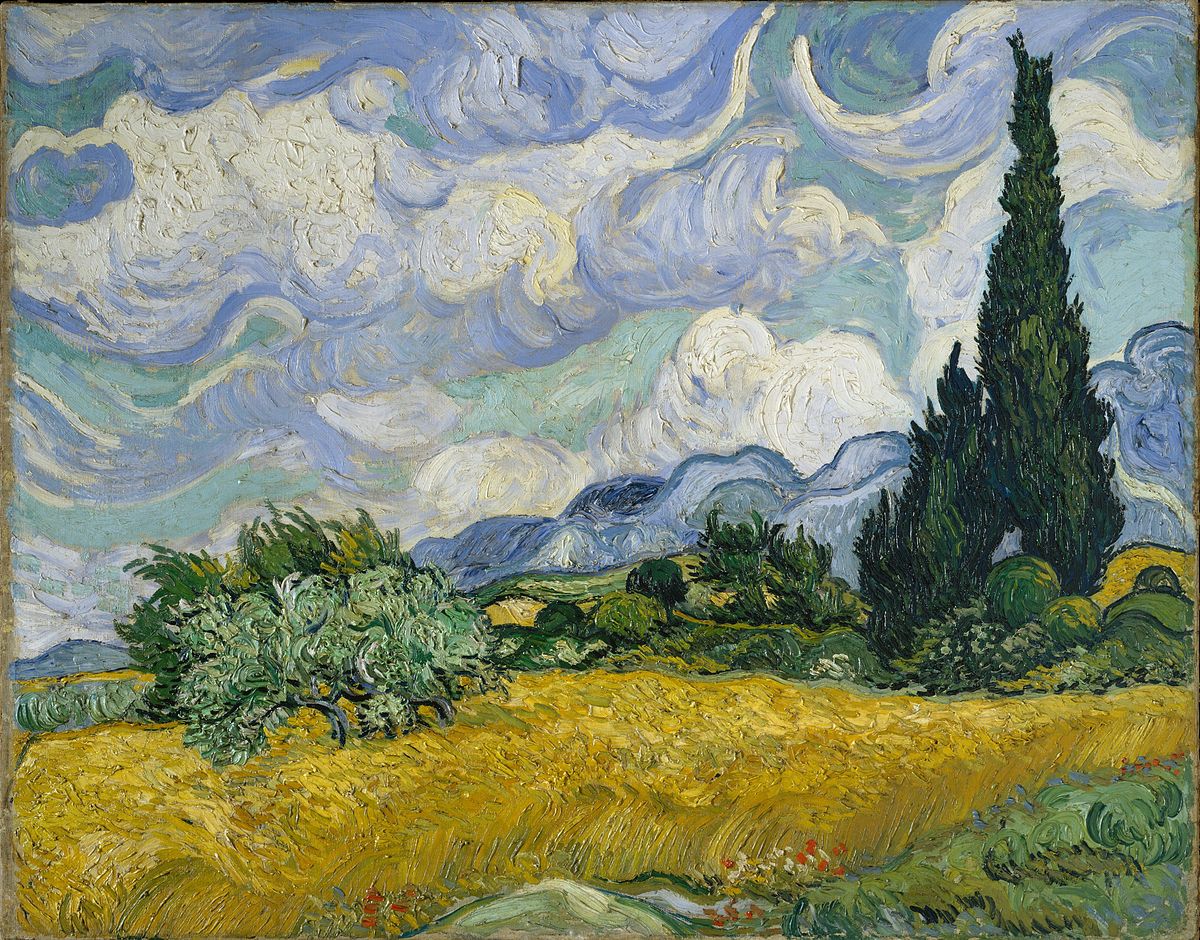
An Ekphrastic Poem


wind rustling through emerald foliage
swaying golden wheat stalks 
great, billowing blue clouds
like a stormy ocean’s violent waves
impasto brushstrokes melting into each other
in graceful, vigorous harmony
convergence of light, color, movement
a singular point in time

Nature, this is how I feel you;
a moment, inimitable